–
Financial advisors are standing at the intersection of several historic, tectonic shifts. Over the next decade, we are poised to witness a staggering $124 trillion transfer of wealth. Simultaneously, the industry could be facing an unprecedented talent shortage, due in large part to aging boomers stepping away from their companies. And then there’s the rise of AI, whose rapid advances are rocking the markets and advisors’ value.
Many folks I talk to believe this convergence of variables has put the whole industry on shaky ground. But today’s guest shares my view that while this might be a bad time to be a good advisor, it’s a great time to be a great advisor, especially if you’re willing to reposition your value prop from money management to high-EQ, high-end financial coaching.
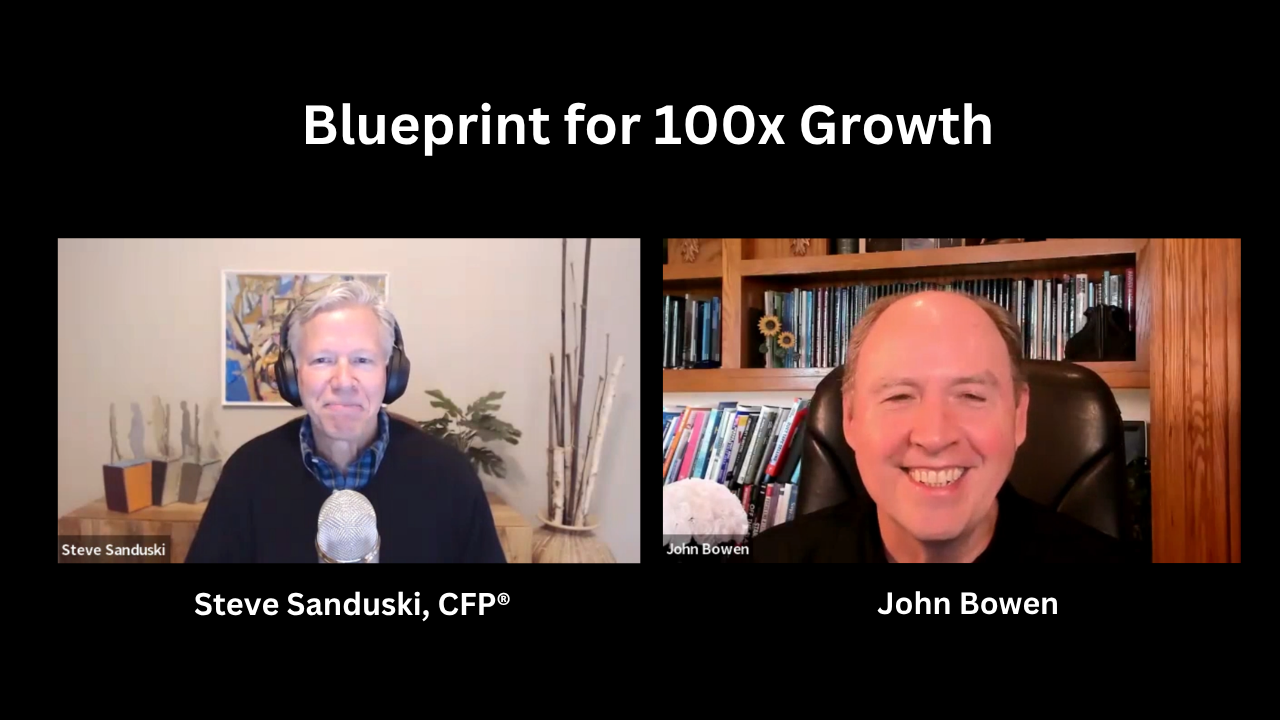
My guest today is John Bowen, the Founder and CEO of CEG Worldwide. John and I discuss how advisors can capitalize on the industry’s massive demographic and technological shifts. We also talk about John’s new book with Dan Sullivan, The Greater Game, which explores why a small fraction of entrepreneurs achieve exponential success and the vast majority get stuck on plateaus.
3 Insights from John Bowen
1. Master Complexity and Move Upmarket.
The more powerful AI planning tools become, the more commoditized a standard financial plan will become. Folks who have $1 million or less in investible assets, an employer-match 401(k), and maybe a summer cottage are going to turn to streamlined apps and online platforms.
And advisors will be staring at fee compression. Unless you reposition yourself as a premium service provider for high-net-worth clients whose financial needs are more complex.
According to John’s research, among households with $1 million to $5 million in investable assets, roughly one-third are business owners. Move upmarket to households with $5 million to $25 million, and that number shoots up to 75%. For households with $25 million or more, 90% are business owners.
These ultra-high-net-worth entrepreneurs want a personal CFO to coordinate their complicated lives. Whether they have a tax question or need to refine their succession planning, they want to make one phone call and go back to work.
And if you can’t be that one phone call? If you’re still just delivering table stakes money management?
Well, that’s why John says 59.2% of successful entrepreneurs tell him they want to switch their primary advisor within the next two years.
“I very quickly identified five things that clients want. Number one, they want help on the investments, and every survey over the last 20 years we’ve done, number one thing is investments, so it’s great for our business. Second is mitigating taxes. Third is taking care of the heirs, the estate planning. Fourth is protecting assets from being unjustly taken: litigation, divorce. And the last one is charitable giving. And if we shoot in the business owners in there, depending on where they are in their business cycles, succession exit.
“And the thing that’s terrible, 6% of high-net-worth and ultra-high-net worth clients think they’re receiving that today. When I surveyed the advisors, 84% say they’re doing it. It doesn’t count if you think you’re delivering it if the client doesn’t perceive.”
Some larger firms are improving their menu by adding tax planning and legal pros to their teams. But you can also assemble what John calls a “virtual family office” via a network of collaborative professionals who can serve all off your client’s needs.
You’re still that all-important first call. Then your team and your support network do the rest.
2. Leverage AI as a Teammate and Trainer.
John’s research indicates that 43% of top financial advisors are actively considering leaving the profession in the next five years.
I’m skeptical that this is going to cause a massive advisor shortage. But it’s true that we haven’t always done the best job of attracting young talent or older workers looking for a career pivot. Nobody likes “paying their dues” or cold calling. And rote back office work rarely develops the kind of people skills that great advisors need.
Through his new venture, the FA Institute, John is harnessing the power of AI to creating an entirely new on-ramp for the next generation of advisors.
“One of the best learning vehicles is AI. ChatGPT has a learn function. You just say, ‘I want…’ We’re building synthetic data. We can now do over 1,000 different avatars to practice. The idea is that just like you and I are on Zoom right now, you can dial up what type of client you want. And we have 25 years of data. It will do the behaviors, their net worth, everything. You can have a conversation, the initial meeting or with a COI and so on, and it’s unbelievably good. It doesn’t make any sense to go have people knock on doors, dialing for dollars, that type of thing. Why don’t we use AI and bring them through at their pace?”
By utilizing AI as a dedicated trainer and teammate, new advisors can dramatically shorten the learning curve. And AI planning tools are making money management and basic planning quick, routine processes.
But there’s nothing routine about the needs of a multimillionaire small business owner who’s trying to keep his company and his family in the black for decades to come.
High-net-worth clients need an advisor who utilizes AI to augment their human capabilities, not replace them. Ultimately, even the best AI output is still just a collection of data points. Wealthy clients need your expertise to coordinate strategies and provide genuine relationship value.
3. Adopt the “Architect” Mindset to Multiply Your Success.
While writing The Greater Game, John and Dan Sullivan studied over 6,000 successful entrepreneurs. They discovered that only 5.4% of these entrepreneurs were breaking away from the pack and achieving massive, compounding success. The remaining 94.6% were simply grinding it out, working harder and harder for diminishing returns.
John believes that these trends apply to the typical “life cycle” of a financial advisor as well:
The Builder, who’s just trying to survive every day.
The Grower, who’s gaining traction but stuck on a treadmill.
The Operator, who’s running a successful business that’s too dependent on him.
It’s only when you become your firm’s Architect that meaningful, sustainable, organic growth is possible. From that high perch, you’re removed from the daily grind of the business and free to redesign what your firm looks like, how it operates, and whom it serves.
“Put the systems in place so you move from being kind of a personality-driven, founder-driven, entrepreneurial type to more of an enterprise. Success becomes a trap You’re winning, you get burnout, and it’s misaligned. So if you’re indispensable, the founder dependent, typically — and this is across all industries — 3-to-5X. When you have a self-managing business, it’s 10-to-15X. I sold a $2 billion business for 16X EBITDA, and the reason was that I wasn’t needed. And it continued to grow like crazy when I left.”
Becoming an Architect means less time doing day-to-day tasks and more time delegating. It means developing intellectual property and systematizing the client experience. It means shifting from one-off marketing tactics to building a collaborative community around your clients, prospects, and centers of influence.
And it means designing a business that gives you autonomy.
Reach that point, and John says the returns will be exponential — for your company, and for your life.
“Most of us get a little burnt out doing the same thing over and over again, and when you start reinventing yourself and start thinking the architect mindset and creating the systems, you’re going to create more value for whatever you want to achieve. I’m 70. I love what I’m doing. I’ve designed the businesses so that we have to not be dependent on me, and at the same time to really have the lifestyle that I want to have. There’s no reason for anyone in our industry not to. You may not have that on day one, but you should certainly have that vivid vision to build toward and then put the systems in place to achieve it.”
John Bowen’s Warning for Advisors
Don’t Stall at the “Good Enough” Line.
So why don’t don’t we have more Architects in finance?
Because it’s been easy to be complacent.
The markets go up. Your AUM goes up. Your income goes up.
And a lot of this growth happens almost on autopilot. Maybe an event or two every year, a social media post every week, and the markets take care of the rest.
Your firm might not be “great.” But it’s “good enough” for you to make a living, pay your team, and keep your clients’ retirement accounts growing.
All that’s changing.
Sure, the markets will probably keep marching up and to the right. But advisors can’t keep assuming their value prop will automatically rise in tandem. And if some of the tailwinds we’ve been taking for granted turn into headwinds, you’ll stop coasting and crash.
“I think too many advisors are going, ‘I have to get the chips off the table because I don’t know how I’m going to go beyond this ‘good enough’ line as an operator and go to the architect.’ That’s okay. That’s a decision. If that’s the right decision for you, that’s great. But there is an opportunity to be successful on purpose and really restructure.
“ Don’t try to do it alone. Find somebody that you trust, you have confidence in, whether it’s a coach or a consultant, and really have a conversation. I started CEG because when I was an advisor, I always felt like I was in an entrepreneurial fog. And now I feel like a kid in a candy store. I’ve got all the research of both the empirical and the applied experience. We know exactly what works now. So find somebody that you wanna work with that can make a big difference. I want to encourage everybody to not stop growing. Think, ‘Am I at that good enough line that I’m kind of content, but I’m frustrated?’ That’s usually where the deals are done. And now let’s create a new vision, and create tremendous value for others, and do well by doing well.”