The launch of advanced AI models capable of writing code and executing complex tasks has coincided with a sharp drop in the share prices of some large financial service companies. The market is reflecting the reality that the traditional, technical, number-crunching value proposition of a financial advisor is rapidly being commoditized.
But what does this mean for the individual human advisor and the RIA CEO?
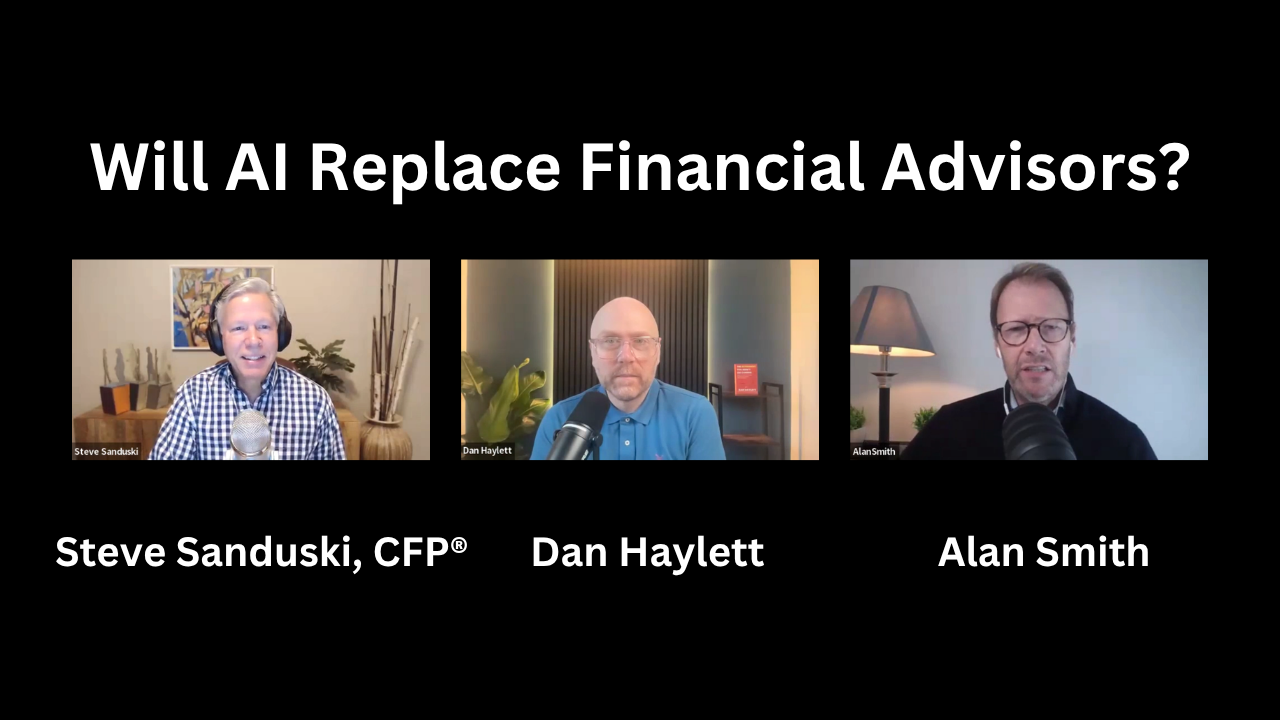
On today’s show, I discuss the future of financial advisory with Dan Haylett, Marketing Director & Financial Planner at TFP Financial Planning, and Alan Smith, Founder and CEO of Capital Partners. Will AI cause short-term disruptions that ultimately expand the market, lower costs, and elevate the premium on human wisdom and relationship-building? Or are AI optimists suffering from an “empathy delusion” in our belief that AI can enhance — but never replace — the human-to-human connection that’s always been an essential part of our value proposition?
3 Insights from Dan Haylett and Alan Smith
1. Your Firm Could Be the Next Spotify … or the Next Record Store.
In Dan and Alan’s home base, the UK, only 9% of adults pay for formal financial advice. The vast majority of the population remains unadvised due to cost, accessibility, or a perceived lack of value. AI has the potential to dramatically lower the cost of basic financial guidance and expand the total number of people receiving advice.
However, Dan Haylett notes that a bigger pie does not necessarily mean an expanding client base for traditional advisors. Look at what happened to the music industry during its digital disruptions:
“MP3s, streaming, ‘People will go more access, bigger audience, technology is a complement, not a replacement.’ Spotify alone has 600 million users, so there’s more people listening to music than there was before. The pie got bigger. But the people who earn a living making music, their income collapsed. Record shops have gone, physical distribution’s gone. I think there’s now three labels that dominate 80% of the music industry. So the pie got massive, but the actual underlying thing that served it got a lot smaller. The middle market gets hollowed out. If the stats are already like this and the sliver gets smaller, how many people do you need to serve? What does that mean for people that are doing this other work and where do they go if people need different services and not just full fat financial planning that requires a lot of human input and conversation? The financial planning business of the future, I think, has multiple different service options that aren’t all different service levels of face-to-face financial planning. I think we need to make sure that there is an ability for people to get great financial planning across multiple platforms.”
Alan Smith points to the travel industry as another instructive example. You probably haven’t booked a flight via a human agent in years. But there’s still a subset of frequent travelers with specialized needs who will pay a premium for that human-to-human service — especially in emergency situations when they need help changing complicated itineraries on the fly.
So, if your firm currently operates in the “middle market,” providing generic advice and generic technical skills to generic clients, you’re a commodity that AI will replace. You’re a record store.
You have to move upmarket and become a one-stop shop for complex, high-consequence decisions. Kind of like how Spotify can offer multiple “streams” of value to its users.
Otherwise, you’re going to become obsolete.
2. Clean Your Slate.
Many longtime advisors came up through the “pod” system: a lead advisor, a paraplanner, and an administrator. Your office might still look like this today.
Should it?
Instead of trying to optimize this legacy system, Alan believes that advisors need to perform a “clean slate” exercise.
Imagine you were launching a new firm. No entrenched systems or tech stacks, no employees set in their ways, no client base, and no built-in assumptions about how things should be done.
What would you diagram on your clean slate? What would you build? Whom would you hire to help you? And whom would you target as your ideal client?
Rather than fearing AI, Alan says AI should be part of the blueprint:
“Right now you would say, ‘You don’t need three people to do that.’ If I was starting from scratch today, I’d have a lead advisor and he or she would be completely AI enabled, possibly with some sort of administrative support, almost as a quality control person because we’re not yet fully reliant on AI and trusting it implicitly without some checking. So that’s a third of your headcount, on a pod system, which could be replicated across a business. But then the opportunity exists to really retool the entire business now. It’s very difficult if you’ve got an existing business in place and you’ve got employees and a team of people who are reliant on the work. But that’s the kind of mindset that people ought to be thinking about.”
The tools exist right now to expand your firm’s capacity while keeping your headcount flat. Dan noted that his firm recently lost a trainee paraplanner and a client experience manager. Instead of replacing them, Dan used AI to “vibe code” a bespoke onboarding app in a single day.
Where does that leave the rest of your pod?
According to Alan, with more time to deliver more value to clients.
“The financial plan and the technical advice, that was never the product. The relationship was the product. And unless you are going to just give up on human relationships, then I think the opportunities are great. We’re going to have to be dynamic. We’re going to have to adjust and adapt. And the travel agent analogy is probably a reasonable one for what we are doing. Let’s do it, because there’s a lot of creativity around in our sector and maybe we got a bit lazy over the years. Maybe it’s been quite straightforward: you win a classic baby boomer client and they come in with a million-dollar pension and you build a financial plan that’s quite straightforward. So maybe the time is for deeper thought, more ideas, more creativity.”
3. Coach Up Your Community.
As AI takes over more and more of the math, projections, and simulations, the the human advisor will need to focus more on coaching behavior and psychology.
That means RIA CEOs need to start redefining what they’re looking for in next-gen talent. Sure, you’ll always need detail-oriented planners. But, moving forward, creative thinkers who possess strong interpersonal skills and empathy will also be in high demand.
As Alan notes, during those high-pressure “fight-or-flight” moments when folks get nervous about their money, AI might be able to offer technical advice. But what people really need is a person who can say, “I understand what you’re feeling. I’ve helped folks through situations like this before. Let’s talk this through and come up with a plan you’re comfortable with.”
Dan goes a step further and argues that once AI can tackle portfolio management solo, human advisors will need professional training in other disciplines to justify premium fees:
“I do think, formally, most financial advisors of the future will need to have genuine training and qualifications in psychology, in therapy, in counseling, in communication, in coaching. And I think, alongside their CFP®, that 2030 planner will have visible credentials in that. If your qualification is only technical, you are offering the thing that AI already does better than you quicker and cheaper. So I do think that behavioral coaching, counseling, and therapy formally comes into this role and I think we’ll get a lot of people that change careers from that background and move formally into delivering this kind of financial planning work.”
Alan believes that community could become another key differentiator in a crowded, AI-powered marketplace.
“There’s a real demand for networking events and meeting up and having community. That’s also something of a moat. If you are the go-to financial person, of course you’ve got those listening skills and rapport building. But if you’ve also got that network of other humans that you can bring in as part of your inner circle, I think that will help. If you think of the worst type of advisory model to have right now, it is a generic advisor that deals with everyone and anyone and delivers technical skills and pension funding calculations for them. I’m still saying they’re not going out of business overnight. But they’re not going to grow. People are not going to seek out that type of more generic advisor.”
Dan Haylett’s Warning for Advisors
The Empathy Delusion
I’ve been something of an AI optimist because I believe that, as the tech keeps getting better, it’s going to free advisors to spend more of their time on high-value, human-to-human service that software just can’t replicate.
And I still believe that.
But …
The more I learn about AI and integrate it into my daily workflow, the quiet, nagging voice in the back of my head becomes just a little bit louder.
“What if you’re wrong?”
There have already been studies of patients reporting that AI chatbots are more empathetic than human counselors. Dan believes these could be early warning signs that advisors shouldn’t bet the future of their firms on the assumption that people will always prefer financial advice delivered with a human touch.
“My thought process was just trying to take this slightly uncomfortable stage further and just go, ‘The financial planning professionals across the world that I follow and I hugely respect, what are they saying at the moment?’ And this phrase ‘We’ve always got empathy’ kept coming up. ‘It won’t replace the empathy.’ Is that honestly true? I called it the ’empathy delusion,’ why financial advisors are making the riskiest bet of their careers. What if AI does an amazing job at empathy? What if this constant improvement will continue to be made? What if the stats coming through about how it’s impacting people positively with mental health and therapy starts coming through to this delusion? Are we just saying, ‘We keep going. It’s empathy. We’ve got empathy. We’ve got empathy.’ It’s fine until we haven’t got it. It’s that kind of Blockbuster moment where no one will stream movies until everybody streams movies and we don’t have any physical stores anymore. I’m not saying AI can do everything, but the way that I saw people talking was that it’s going to take none of that pie. My point is, what if it takes 80% of that pie? What if it can deliver certain things that go outside of the numbers?”
Dan’s ultimate challenge to advisors is to practice “radical self-honesty.” Look at every single task you and your people perform and ask yourself, “Could AI do this as well or better than one of us?”
Zero in on the tasks that you and tour team are still best at and build your value proposition — and your future — from there.