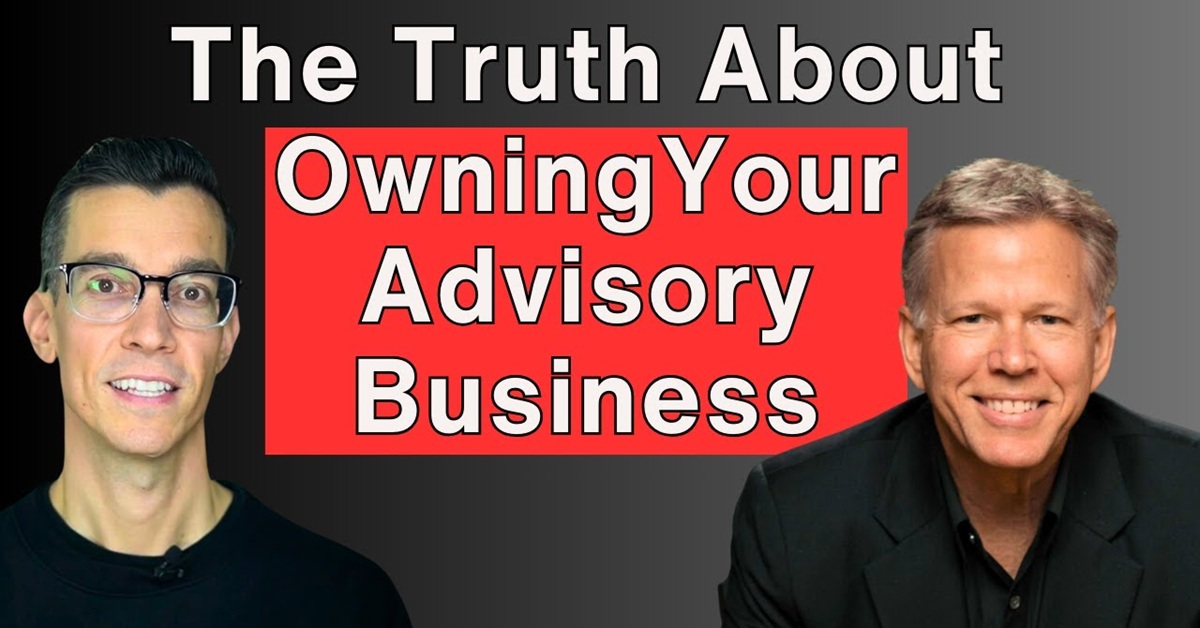
I recently had the pleasure of joining Dave Zoller on his YouTube channel, Streamline My Practice, to discuss something I’ve been thinking deeply about lately: the difference between owning a business and being owned by your business. If you’re a financial advisor wondering whether you’ve built a thriving enterprise or just created a demanding job for yourself, this conversation is for you.
–
The Four Levels of Advisory Business Evolution
During our conversation, I outlined what I see as the four distinct levels of business growth in our industry:
Level 1: The Lifestyle Practice
This is where one main advisor (maybe with one or two others) has built something wonderful – perhaps generating $500,000 to $1 million in personal income annually. There’s nothing wrong with stopping here if this fulfills you. Many advisors are perfectly content at this level, and that’s completely valid.
Level 2: The Partnership Model
At this stage, you have two or three partners sharing responsibility. The business no longer rests on one person’s shoulders. You have systems in place, multiple advisors, and you’re running a multimillion-dollar operation.
Level 3: The C-Suite Business
Now we’re talking about a real enterprise. You have a CEO, COO, CFO, CMO, CIO, Chief Compliance Officer – a full executive team. Typically, this starts happening around the $1 billion AUM mark (roughly $7-10 million in revenue) and additional execs are added as the billions multiply. If one C-suite executive leaves, the business continues thriving because the systems and team are that strong. This creates real enterprise value.
Level 4: The Investor
This is aspirational for most, but it’s worth understanding. Think Warren Buffett before he retired. He didn’t run his businesses day to day; he allocated capital and made strategic decisions. Very few advisors reach this level, and it may not be your destination, but setting it as an aspiration can push you further than you’d otherwise go.
The Identity Shift That Changes Everything
One of the most important points I made during our conversation is about identity. Moving from one level to the next isn’t just about hiring people or hitting revenue targets – it’s about making a fundamental shift in how you see yourself and your role.
I shared an example of a senior advisor I work with who wanted to hire someone to take over client relationships. Before we even started the hiring process, I asked them a crucial question: “Are you ready to make that emotional shift from being the person responsible for all these families to letting the firm be responsible?”
Their answer was telling: “If you’d asked me that two years ago, I would’ve said no. But now? Absolutely yes.”
That mental readiness is everything. If you’re not truly prepared for the identity change, you’ll sabotage yourself – consciously or unconsciously.
The Power of a Compelling Three-to-Five-Year Vision
I’m a firm believer in the power of vision, but not the kind that sits on a wall gathering dust. I’m talking about a narrative – a vivid, compelling story that describes your life and business three-to-five years from now.
Here’s my challenge: Write that story and don’t stop until it’s a 10 out of 10. If it doesn’t absolutely excite you and get your juices flowing, it won’t be compelling enough to push you through the inevitable obstacles you’ll face.
I’ve been doing this for over 20 years now, and my vision evolves as I evolve. Twenty years ago, it was all about career. Now with kids and grandkids, my priorities have shifted. Your vision should be a living document that you refresh regularly just like you update your clients’ financial plans.
Two Real-World Examples of Extreme Freedom
Dave asked me about advisors who’ve successfully built businesses that can run without them. I shared two powerful examples:
Jon Jones of Brighton Jones took an entire year off in 2013 to travel the world with his family. But here’s the key: he started planning for it eight years earlier. He implemented what he called “Get-Keep” – making sure he had people in place to get new clients, keep clients, get new team members, and keep team members. When he left, the firm was doing $18 million in revenue. When he returned a year later, it was bigger. Here’s a link to my great interview with Jon where he shares this story in detail.
Dennis Morton and Katie Brown of Morton Brown Family Wealth implemented a five-week sabbatical policy when their firm was under $3 million in revenue. Once you hit five years with the firm, you get five weeks completely unplugged. Dennis took his sabbatical in 2023, Katie in 2024, and now multiple team members have taken theirs. It’s working at a much smaller scale, proving this isn’t just for mega-firms. Listen to the Michael Kitces podcast where Dennis explains this.
Everything is proportional to where you are, and everything is achievable if you’re serious and methodical about it.
Practical Steps: Start With Your Org Chart
If you’re feeling overwhelmed by all this, here’s where to start:
- Create that three-to-five-year vision (make it a 10/10).
- Build an organization chart for that future state.
- Identify YOUR specific role in that org chart. (It might not be at the top!)
- Work backwards to identify the hiring sequence and trigger points.
- Take it one step at a time.
Don’t beat yourself up when you face setbacks. They’re part of the journey. And please, appreciate where you are right now. If you’re listening to this, you’ve hit the jackpot. Be grateful for the journey while staying clear-eyed about your current reality and optimistic about your future.
A Word on Technology and AI
Dave asked about my crystal ball prediction for the industry. Here’s something that might surprise you: I believe the biggest change in our industry since 1993 wasn’t technology – it was the business model shift from commissions to fee-based assets under management. That recurring revenue model is what enabled everything else to follow.
As for AI? The jury’s still out. I don’t think it will replace financial advisors except at the margin. Yes, it makes us more efficient, but we’re still doing the core things we did 30 years ago: meeting with clients, creating financial plans, being behavioral coaches, managing investments. Technology may actually make it harder to get clients in the $1-3 million range as DIY options improve, but human advice will remain valuable for those who can afford it.
My Final Thoughts
Don’t confuse ownership with leverage. If the business owns you, you don’t really have leverage. You just have a high-paying job.
Understand your mindset. Is it helping or holding you back from where you want to go? The way you approach challenges and inflection points in your business matters enormously.
And here’s my note of optimism: Every person reading this has the ability and opportunity to achieve whatever you want to achieve. Don’t be swayed by comparing yourself to others who get all the glory and publicity. Be you. Do you. Focus on what makes you happy and what serves your clients well.
If you set that three-to-five-year vision and you’re serious and methodical about it, you can absolutely get there.
Here’s to your journey from owner to investor, whatever that looks like for you.