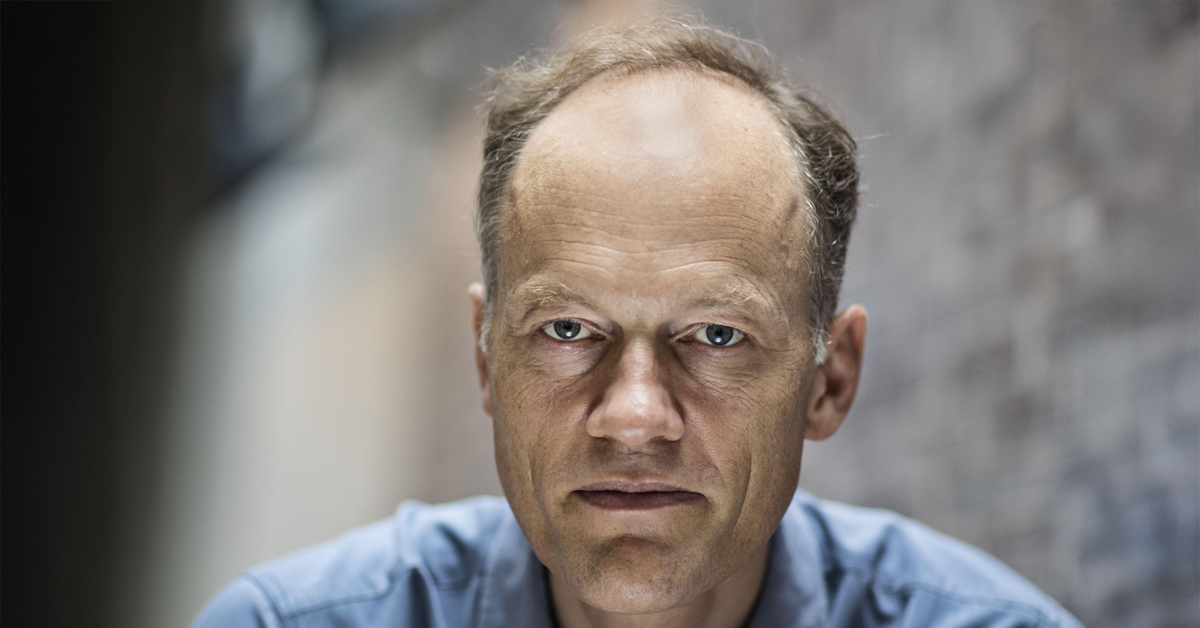
Guest: Sebastian Mallaby, the Paul A. Volcker senior fellow for international economics at the Council on Foreign Relations. Paul is also a longtime journalist and commentator and the author of five books, including The Power Law and The Man Who Knew, the definitive biography of Alan Greenspan.
In a nutshell: We’re at an unprecedented moment where central banking, political power, and artificial intelligence appear to be on a collision course. Who holds the advantage as these battle lines are being drawn? The Federal Reserve? Venture capitalists? Tech firms? President Trump? China?
On the fourth episode of The Geopolitical Edge miniseries, Sebastian Mallaby explains how central banks are navigating political pressure, how AI might trigger a new productivity boom or a new bubble, and how capital is no longer just about ROI, but about influence.
.Sebastian Mallaby and I discuss:
- How well has the Federal Reserve done its job and what happens if it succumbs to political pressure to loosen monetary policy?
- Will AI deliver massive productivity gains that alter the economy and offset a declining workforce?
- President Trump vs. Fed Chairman Jerome Powell.
- How AI is shifting the locus of financial and political power.
- The “TINA” (There Is No Alternative) Effect and how resilient the U.S. markets are to global uncertainty.
. Quotes:
Sebastian Mallaby on the Fed:
“ How well the Federal Reserve performs is not constant over time. And in some ways, when Alan Greenspan became the Fed chair in 1987, it was sort of the beginning of the consolidation of a good period. In the 1970s it had been pretty disastrous. The Fed had let peacetime inflation really get out of control, and it did that in the absence of something equivalent to the COVID shock. There was the double oil shock in the 1970s, but I think that was a much smaller price shock than COVID was and COVID was just unprecedented with the amount of uncertainty it created. So I, kind of slightly, am charitable about my judgment of the post-COVID inflation. But the 1970s really was a straightforward mistake by the Federal Reserve just not being tough enough early enough to raise rates and control inflation, partly because of the political climate.”
Sebastian Mallaby on the challenges of investing in AI:
“ Even before Mark Zuckerberg was throwing silly money around in the last month or so, the salaries of AI scientists were off the charts. That tells us that the expected value being created by AI scientists and AI engineers is really, really enormous. If you look at the uptake of ChatGPT after it was released in November of 2022, it was the fastest uptake of any online product ever. I think that’s where power does reside in the hands of an amazingly small number of AI builders and finance is kind of just throwing itself at these AI firms to get participation, interestingly, without necessarily a very good theory of how the monetization is going to make it financially sensible. It’s a bigger version of the broadband bubble in the late 1990s where everybody understood building high-bandwidth communications infrastructure was going to be very important. It was an A+ technology but it turned out to be a D- business model. And in some ways AI now looks a bit like that. ChatGPT is by no means a monopoly. In fact, you can switch out and get pretty much the same service from at least two or three or four competitors. And so how do they monetize in the future to offset the enormous costs of buying their data centers, buying the power generation you need? We don’t know. It could be a genius investment. It could be a terrible investment. And so I do feel like finance is chasing talent where talent has the upper hand.”
Sebastian Mallaby on redesigning the modern portfolio:
“I think today allocating money is as challenging as I can ever remember. I do really think that this is a super uncertainty because you’ve got the geopolitical uncertainty, you’ve got political and domestic uncertainty with the current administration. Then you’ve got this extraordinary technological upheaval with artificial intelligence, which is just on a different magnitude than what the internet was, I believe, in terms of the impact it’s going to bring. So it is difficult, and I think difficulty means I would sort of advocate a kind of barbell strategy here. One is that, you’re playing defense to some extent. You’re diversifying your bets because it’s uncertain and your portfolio needs to account for the fact that we could get a big spike in inflation if you had a different Fed chair who did cut rates. You need to be a bit hedged against inflation. I still believe in U.S. preeminence, but I think it’s less certain than it was two years ago. I think now being a little bit more global in your allocation probably is smart.
“And then I would think about AI. It’s going to drive up productivity, it’s going to drive up growth rates. Real estate in the center of desirable cities has to go up because there’s going to be a bigger GDP and it’s going to be unevenly distributed. In a world where you can’t tell whether Nvidia wins or Google wins or Meta wins, some sort of collection of bets that you can get into directly in AI and energy and data centers makes sense. But then the classic positional good is real estate and positional goods survive inflation, survive inequality, and I think that’s a pretty good bet.”